You taught Android your brightness preferences and it is still wrong. Tideo
replaces the opaque on-device ML of stock adaptive brightness with deterministic,
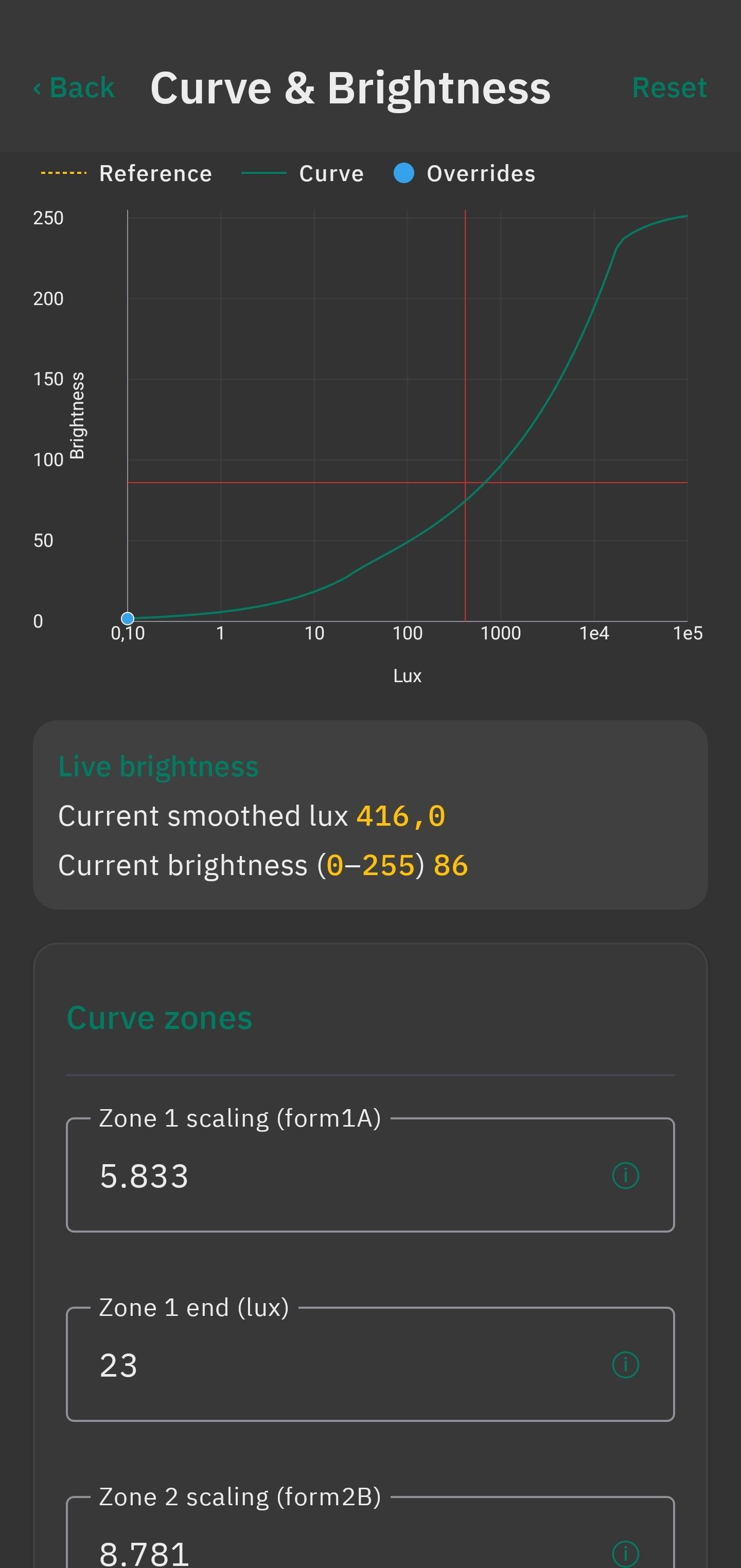
inspectable math: a tunable lux-to-brightness curve you can see and shape, smooth
animated transitions, circadian (time-of-day) scaling, per-context overrides, and
an optional privileged "super dimming" mode that takes the screen below the system
minimum.
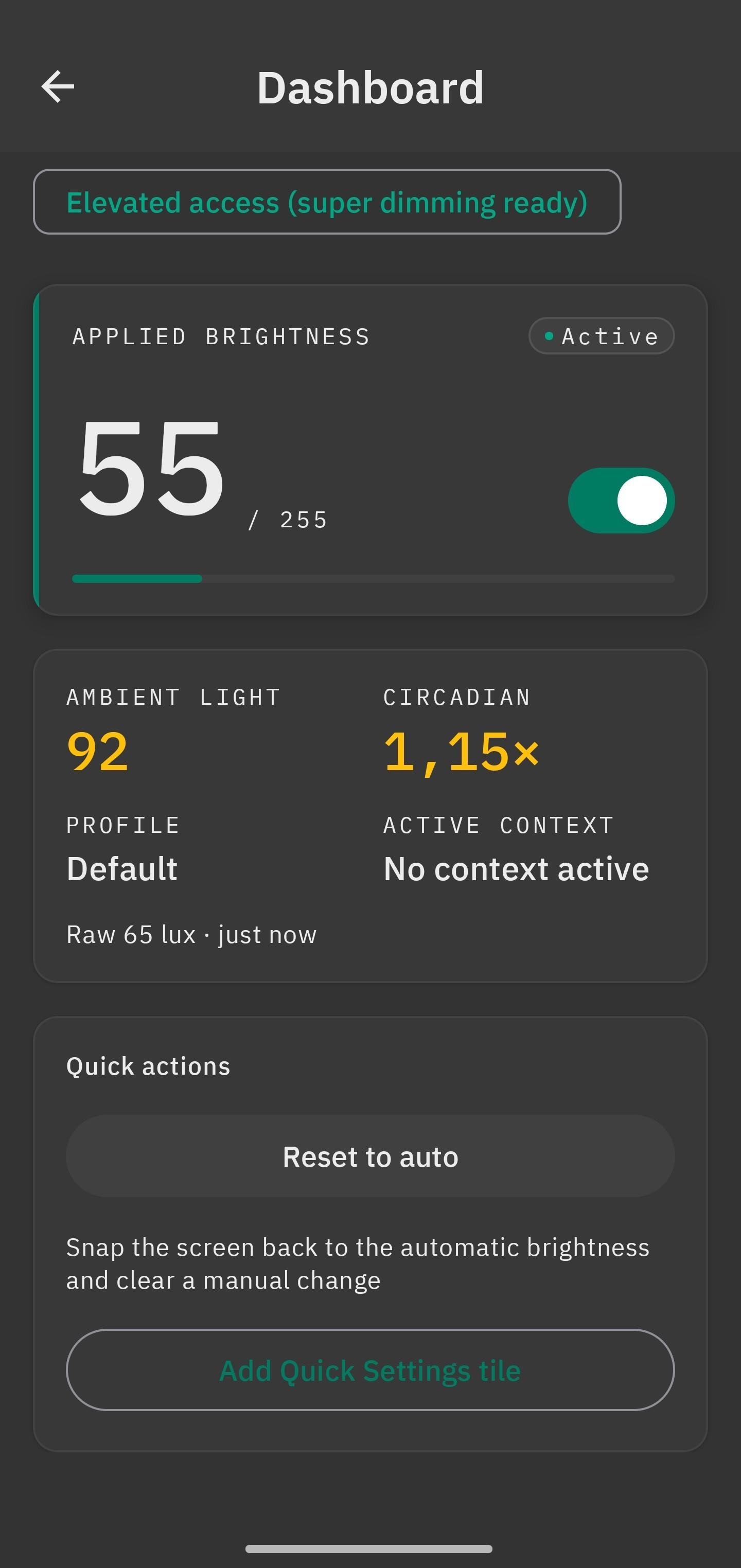
To use it, first disable the system's stock Adaptive/Auto Brightness
(Settings > Display), then launch Tideo, complete onboarding, and toggle the main
service on from the Dashboard.
Features:
* Three-zone perceptual brightness curve with a live, editable graph.
* Automatic curve fitting: adjust brightness by hand during normal use and, after
a handful of points across varied lighting, the wizard suggests a fitted curve.
* Reactivity control: per-range dead zones that kill sensor jitter without making
the screen sluggish.
* Smooth animated transitions with override detection: drag the system slider and
Tideo steps aside, then resumes per your rules.
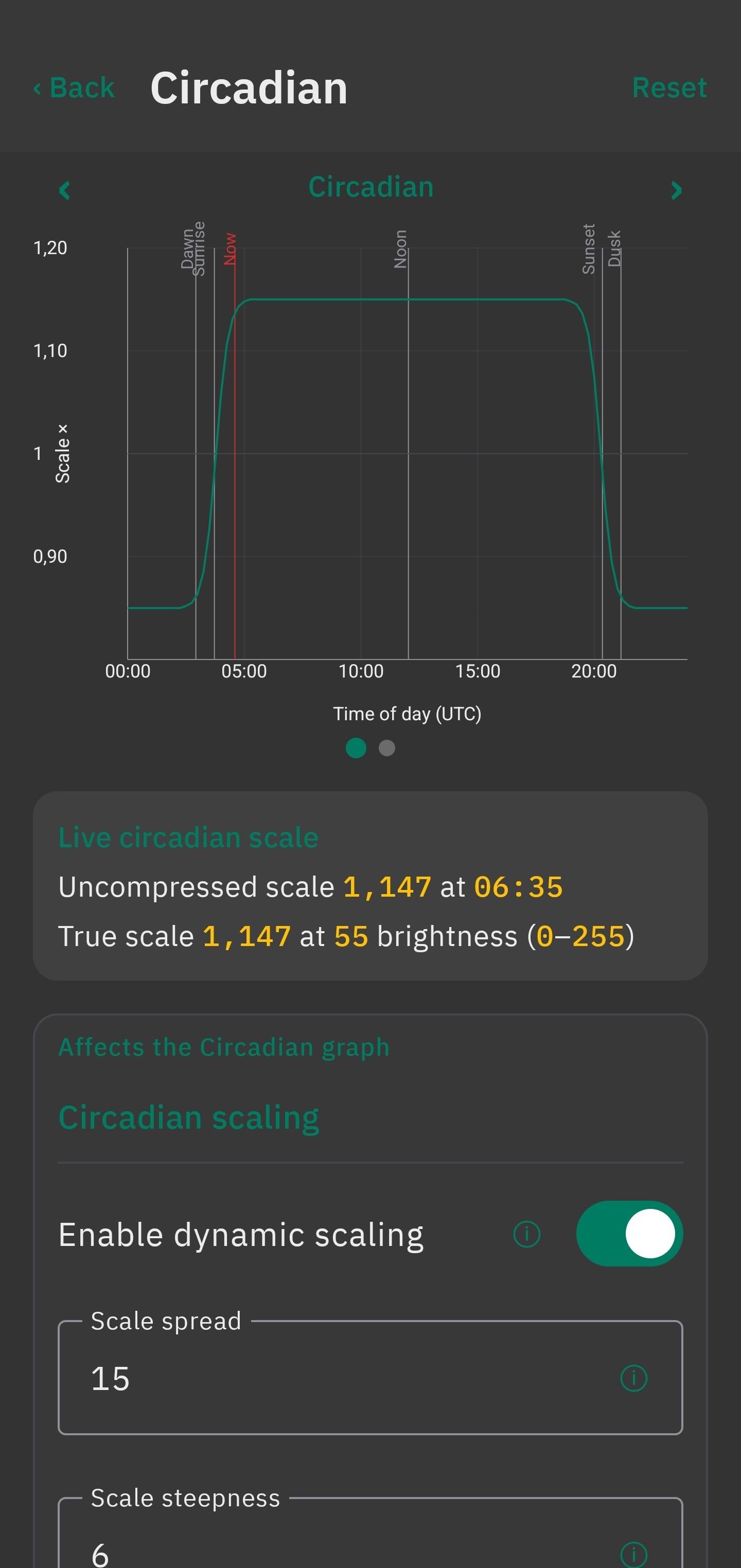
* Circadian scaling synced to local sunrise/sunset, shifting the whole curve
across the day.
* Super dimming (privileged): drives Android's Reduce Bright Colors below the
hardware floor, plus a PWM-flicker-aware software-dimming mode.
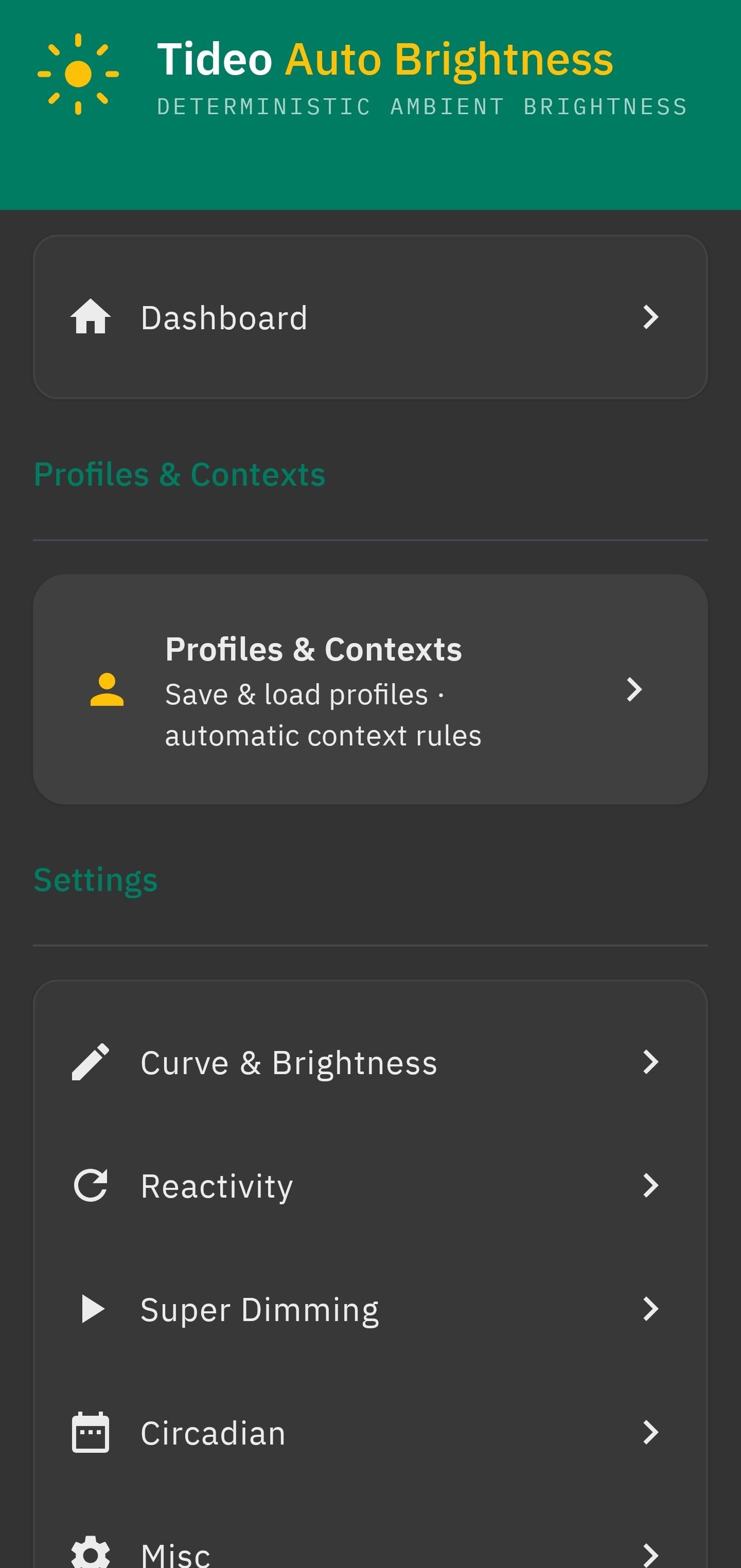
* Context automation: load profiles automatically by foreground app, time window,
location, charging state, Wi-Fi SSID, or day of week.
* Profiles: five built-in presets plus save / overwrite / factory-restore and
JSON import/export.
* Live Debug scene: a glass-box readout of every runtime variable and decision.
* Emergency recovery: flip the phone upside-down and shake to force brightness to
max with an SOS vibration.
* Surfaces: foreground-service notification with actions, a Quick Settings tile, a
home-screen widget, and boot-start.
Privilege tiers:
The core pipeline is fully functional at the BASIC tier, which uses only the
user-grantable WRITE_SETTINGS permission. The optional ELEVATED tier unlocks super
dimming and requires a one-time WRITE_SECURE_SETTINGS grant that YOU perform via
adb, Shizuku, or root. It is never granted automatically.
About the permissions Tideo requests:
* Background location and location: used only by the optional location-aware
context rules and the once-a-day sunrise/sunset refresh for circadian scaling.
* Usage access (PACKAGE_USAGE_STATS): used only by per-app context rules to read
the foreground app; granted from a Settings screen, not a runtime dialog.
* Accessibility service: optional and presentation-only. It draws the debug/context
flash overlay system-wide. It does not read screen content and does not consume
input events. With it off, Tideo falls back to a foreground toast.
Privacy:
Tideo is local-first with no analytics, ads, or accounts. It makes one outbound
network request, and only as a last resort: if you opt in and enable circadian
scaling and no on-device location is available, it falls back to a single HTTPS
request to ipwho.is to estimate your city from your public IP. This fallback is off
by default and can be turned off under Circadian > Date & location. Automatic lookup
runs at most once per day, and the resolved coordinates are saved only on-device;
the user-triggered Use current location action can make an additional request after
on-device location fails. Everything else runs entirely on-device.
Tideo is a ground-up Kotlin/Compose rebuild of the Advanced Auto Brightness Tasker
project, ported with exact behavioural parity. It is not affiliated with Tasker.